
Thoughts on "The Solution Selling Fieldbook"
B2B Sales Methodology📖 What is Solution Selling?
"The Solution Selling Fieldbook" is not just a sales guide, but a complete sales process and management system. It emphasizes putting the "customer" at the center of everything and guiding sales behavior through standardized processes.
Core Components
- Philosophy: The customer is the center of everything.
- Action Map: End-to-end sales process guidance.
- Methodology: Specific sales skills and analytical tools.
- Sales Management System: Helping teams manage and analyze opportunities.
Reflection: This "customer-centric" philosophy coincides with the concepts of industry giants like Huawei and Yonyou. Whether doing sales or projects, understanding the customer's business flow is crucial.
🔍 Opportunity Classification and Mining
The book divides sales opportunities into two categories. Understanding their differences is crucial for formulating sales strategies.
1. Latent Opportunity
- Definition: Customers have not yet realized their problems, or have "pain" but have not sought change.
- Challenge: High difficulty in development, consuming a lot of time and resources.
- Value: Less competition, once developed successfully, customer stickiness is extremely high.
2. Active Opportunity
- Definition: Customers have identified problems and are actively looking for solutions (e.g., active consultation, bidding).
- Challenge: Often facing fierce bidding, customers may already have a preference.
- Strategy: Need to quickly assess, control the process, and prove value.
💡 Pain Leads to Change: The Pain Chain Principle
The book has a very sharp point: "Pain is first perceived by individuals, then spreads to the company, and finally leads to the failure of the organization."
Pain Checklist
Before visiting a customer, it is crucial to establish a "Pain Checklist". We need to anticipate the challenges that customers in different positions may face.
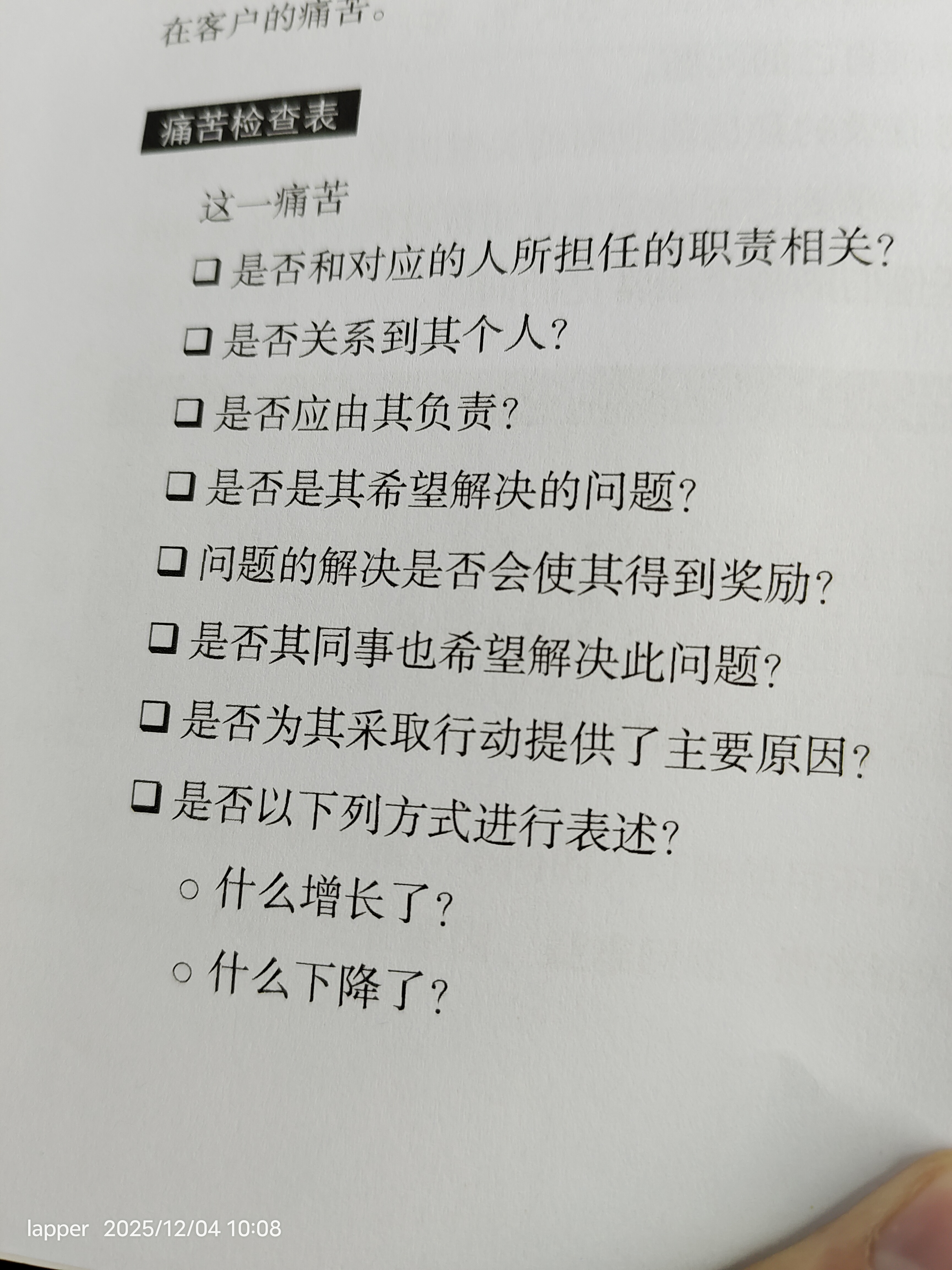 Figure: Example of pain point analysis for different positions
Why Focus on Pain?
- Individuals are the Entry Point: Organizations are made up of people. Solving the pain of key figures can often leverage the entire project.
- Ripple Effect: A problem in one link (such as inventory backlog) will lead to chain reactions in upstream and downstream (such as broken capital chain, production stagnation).
📝 Personal Insights
Even if you don't work in sales, this methodology is valuable:
- As a Developer/PM: We can use the "Pain Chain" to analyze business requirements and find the core value points of the system.
- As an Entrepreneur: It can help us judge the product-market fit (PMF), whether we are solving an "itch" or a "pain".
"If you can clearly grasp the entire sales process, it will help you better cut into the business core when doing projects."